We Need to Talk About Trains


UK Rail is a money pit destroying prosperity and enforcing London's dominance to the detriment of the rest of the country. 

This I suspect is going to be a very unpopular post because everyone loves trains. But…

Here’s a chart from wheredoesitallgo.org It’s a detailed breakdown of the UK Transport Budget for 2025/6.
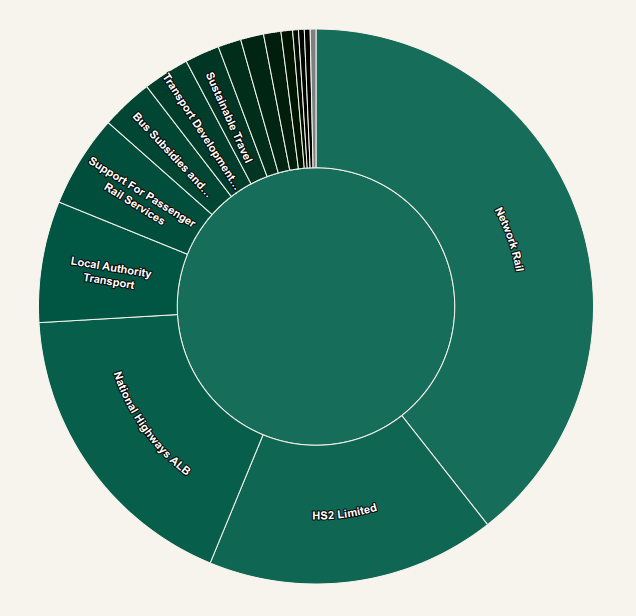
According to the chart 63% of the entire budget gets spent on rail. Most of it as a continual annual liability to support the current rail infrastructure and attempt to make tickets somewhat less than prohibitively expensive.

Actually the amount spent on rail is £3 Billion more than shown here. The missing £3 billion is hidden in budgets to “Local Councils” and “Devolved Governments”

A significant amount of the budget is being spent on the development of HS2. That is the building and commissioning of a new rail line from London to Birmingham.

In fact the annual amount being spent on HS2 alone is just short of the entire budget used to maintain and upgrade Britain’s Motorways and major roads (The Strategic Road Network or SRN)

The total amount spent on Rail is just less than four times that spent on the Strategic Road Network (see National Highways ALB in the chart). So it would be reasonable for you to expect that the number of passengers travelling by rail would far exceed the number travelling on the Strategic Road Network.

But if you did think that was the case or even if you thought they would be somewhat similar, you would be wrong. And by wrong, I mean wrong in Spades.

Just 8% of passengers travel by rail. Meanwhile 34% travel on the Strategic Road Network. About 50% of all passengers travel on roads maintained by local councils

In total ten times as many passengers travel by road (of all types) than by rail.

Four times as many passengers travel on the SRN than travel by rail. Yet the SRN gets just one quarter of the money from the transport budget to that lavished on Rail.

The net result of this is that each passenger on the railway on average gets around 16 times the amount spent on them from the Transport Budget than does a passenger on (say) a motorway travelling in either a car or an National Express coach..

So Where it all Get Spent?

Even though each railway passenger gets about 16 times the spend than a road passenger gets, surely with all the talk of levelling up, it means that a great deal of that money is spent up North?

Sadly: No.

Most of that money is spent in and around London. 70% of all rail journeys are focused on London. Of that 70%, almost all (88%) is commuter traffic. The net result is that 60% of all rail journeys in the UK are accounted for by London commuters. Just 10% of all UK rail journeys are inter-city.

At the end of the day, non London rail passenger traffic accounts for barely 3% of the total passenger traffic on road and rail in the UK.

That’s how things stand. Nothing is getting better.

Governments of all colours have been obsessed with rail. While the Strategic Road network languishes we have shovelled money into one gold plated scheme after another. The latest debacle is HS2.

Most of the Transport Budget in in reality little more a hidden subsidy scheme for London firms and their employees. They get the Lions share of the budget. While the rest of the country gets the table scrapings.

This can’t (or rather shouldn’t) go on.

In another post (or two - TBD aka in the "future") I’ll deal with HS2 (and rail freight traffic) and how it will make little difference to the North but will in essence act as yet another London transport subsidy for London businesses and their commuters. I’ll also detail how much the subsidy comes to per commuter and how this destroys prosperity, development and job opportunities in the North and regions.

This post was originally published on SubStack but has been moved here. Heres why

Who are the Labour Voters in May 2026?

An occasional series on main political Parties & their demographic support.


First of all I suppose I should possibly title this “Who were the Labour Voters in 2026” because with the rise of the Green Party all bets are off at the moment. As well as that we have the local elections coming up which by the sound of things are going to go badly for Labour. But Local Elections are not like General Elections. They have a much lower turnout and can often be seen as a safe place to make a protest vote.

Consequently I’m using the last two General Elections as the database. I’ve built a table of the demographics for every constituency in the country. This is so I can examine the demographics for every winning Labour seat and potentially see which are vulnerable and which are not.

Labour’s National Vote Base

But first of all lets look at what could be called Labours national core vote

Here’s the total number of people who have voted in every general elect back to 1987


So the Labour vote in 2024 that gave them a landslide victory was actually the third lowest vote they have had in the last forty years. Notably it was considerably lower than that achieved by Jeremy Corbyn when he lost in 2017.

Only in the 1997 General Election was the overall National voter turn-out high for a Labour victory. In 2001, 2005 and now in 2024 the national turn-out was low and in two cases actually below 60%

But it looks like there is (or maybe was) an irreducible core Labour vote of around 9.5 million.

Labour Support by Age Group

So what age group(s) support Labour? Of course all age groups support and vote Labour. But there is a heavy bias towards younger voters.


Even though Labour has a very large lead in young supporters this does not necessarily lead to more votes. Turn-out (aka those who actually vote) for the 18 -24 age group is dismal.

Turn-out by Age Group 2024 general Election


Here’s the estimated turn-out by age group for 2024.


The reason the Ipsos figure is lower is that it includes ALL people within that age group. Many people are not even registered to vote and they do not even show up as non-voters in statistics based on registered voters.

Proportion of Party Vote by Age Group 2024

If you take an average of all the winning seats per party in 2024 you get this:


NOTE: The above figures relate to the electorate size for that age group NOT the number of that age group who voted for the respective party.

Notice how (Nationally) Labour winning seats have a lower overall turn-out and a higher percentage of young voters. Meanwhile the demographics of winning seats for the Conservative, Reform and Lib-Dems are very similar to each other. They have more support from older voters and less from the young than Labour or the Greens.

You may think that a few percent on these averages will make few differences. If they average were the same across all seats that possibly would be true. But the average hides massive differences within parties and particularly within the Labour party.

So Why the 2024 Landslide?

It also helps explain the last Labour victory. The fall in turn-out between 2019 and 2024 of 7.4% meant 3 million voters stayed at home. Older people are the predominant voting group. Statistically their vote per capita is worth twice that of young electorate members. Predominantly the 65+ age group voted for the Conservatives. But in 2024, disillusioned, many stayed at home. More voted Reform.

While Labour lost votes from 2019 to 2024, they lost far fewer votes than the Conservatives. Consequentially they actually won some seats from the Conservatives when they achieved a lower vote count in that particular seat than they did in 2019!

Labour and the Next general Election

This was written before Labour’s calamitous local election results in early May 2026 which were significantly worse than even I was expecting. So I’ll let the dust settle a bit before making any predictions. But I’ll leave what I wrote as a reminder I need to still do this!

But it is not rosy for Labour. They have many seats that depend on both a loyal Labour young vote and a low turnout. If either of those items change (and both may well do) they are likely to get hammered.

In a future post ’ll list the seats I think will either fall to the Greens or get them a close run. At the other end I’ll look for Labour seats that could fall to Reform though I think these are far fewer.

Looking at it the other way round I think it fair to say that the list of seats Labour could win off other parties would be more-or-less empty.

This post was originally published on SubStack but has been moved here. Heres why