Billothewisps posts by Topic

▼

The Advantages of being a small Political Party. (Part 2)

 Prices Law (see last post) is a nightmare for large political parties.

But it doesn’t necessarily apply as-is to smaller parties. So being a smaller party is not all bad. Also being small can give you some tactical advantages over the well resourced, well financed, larger legacy party opposition.

So what’s the difference? Why doesn’t Price’s Law apply to small political set-ups like it does to large parties?

One of the main reasons is a member of a smaller party like (say) the SDP has more skin in the game than a member of (say) the Labour Party.

Being a member a small party requires far more personal commitment than to a large party. You are “out on a limb”. What you are doing is unusual. Instead of following the crowd you are breaking away from the pack. You have stepped away from the comfort of a crowd. Consequently to do this you are far more likely to have embarked on this course specifically to action some form of change.

Whereas a Labour party member is in a huge cosy club where they don’t have to do anything and nobody bothers them. In fact the bureaucracy and tiered elitism actively discourages it.

They can remain anonymous in their comfort zone yet gain all the personal kudos of “doing something”. Whereas in fact they’re just drinking cheap beer down the Labour club.

For a small party this personal commitment gives the leadership the opportunity of engaging with the membership on a much more dynamic level.

Most people in political parties both large and small, join to try and make a difference. But very few (especially in the large legacy parties) are given any significant opportunity to do so.

But in all parties whatever their size have a problem. While members join and want to affect change they literally have no idea what to do to affect that change. Or help it along it’s way.

In essence they mean well. But they don’t know what to do to affect that change. Consequently most end up being paper members. This is inevitable in a large bureaucratic party like the Labour Party but can be ameliorated in a small party.

A smaller party has much greater opportunity to involve it’s membership in policy making and actioning of party goals and aims. Consequently it obeys what is known as The 90-9-1 Law.

With 90-9-1 Law, in a party of 3500 members, approximately 35 are the real heavy lifters, another 315 contribute to varying degrees and the final 3150 are passive.

BUT this law can be tweaked.

There is far, far less bureaucracy and a “who you know” mentality in a small party. If it structures some activities to accommodate occasional participation, it can allow members to dip in and out without demanding long term commitment to any one target/activity.

Everybody hates open ended commitments. So if a small party avoids these where possible, people will be more willing to contribute. The 90-9-1 spread of participation can become more like 80-16-4 but only if contribution is made easier and more worthwhile.

A large party has many more tiers. The average novice member is far more isolated and remote from those guiding the party. They are anonymous. The structure and hierarchy is complex, bureaucratic, confusing and intimidating. There is far, far less potential to get novice members to engage than in a small party. There is little to no leeway in modifying the depressing stricture of Prices law.

A small party is therefore already at an advantage. But in engaging party members in small clearly defined activities a small party can break out from the 90-9-1 Law and so multiply it’s effectiveness. All by simply involving it’s membership in clearly defined, straight forward tasks that have a clear beginning and end.

It just needs to figure out what these tasks need to be.

As you’ve probably guessed there’ll be more on exactly what these tasks are in another post coming in the next week or so.

Bye for now

Love & Kisses

Billo.
The Advantages of being a small Political Party. (Part 1)

Back in the 1960’s Derek J de Solla Price theorised that if you added up all the scientific papers published, you would find that half of the papers published were published by the square root of of the number of authors.

Since then it has been refined and found to be actually (in many cases) even more stark.

Prices law (and it’s derivatives) has been applied to many different fields. Especially in regard to aspects of Human endeavour.

It doesn't apply in scheduled environments. Obvious examples are bus drivers, A&E doctors, train drivers. These are scheduled and constrained and other laws apply here. But for a dynamic organisation say a software company or (dare I say it) a political organisation Prices law and/or it's derivatives described the situation well.

In such large human organisations, Prices law dictates that the square root of the number of members (or employees) do half the activity/work. Think on that.

So an organisation with 9 members, 3 do half the work and the other 6 do the other half.

If it’s a hundred employees then 10 do half the work and the other half is done by the other 90.

If it’s a 1000 then 32 do half the work and the other half gets done by the other 968.

So lets apply Prices Law to a small political party like the SDP* and compare it to (say) the Labour Party.

*[this is actually too pessimistic for the SDP. I’ll explain why in part 2]

The SDP has, I believe, about 3500 members.

So applying Prices Law to the SDP, 60 do half the work and the other 3440 do the other half.

Shocked? Don’t be. Because it is far, far worse for the legacy parties.

Let us look at (say) the Labour Party. Labour has a membership of around 250,000.*

*[In this case Prices Law applies, and I’d suggest is pretty damn accurate]

Barely more than 500 members of the Labour Party do half the work. Remember though, by having 250,000 members there is one hell of a lot of extra administration, overheads and policy discussion.

The “work” of running the party will be considerably higher than that of the SDP, even if Prices Law applied directly (it doesn’t) to the SDP. Many of those 500 active Labour Party members will be soaked up doing admin.

The Labour Party and the other legacy parties as well as organisations like the Civil Service and the NHS have reached a size where arguably any increase in size will lead to less efficiency and less productive output. (Note: Prices Law will only apply to certain aspects of the NHS)

Getting anything done in the Labour Party, like new policies, projects, reviews or even simple governance must be like walking through a quagmire with little knowledge of where you are heading or why. Trying to change course on a failing policy must be a nightmare.

It does actually explain a lot about the lack-lustre nature of the top echelon of the Labour Party. To get to where they are, the top echelon have had to be party careerists and committee people.

Few (if any?) have actually done anything outside politics. Their skills (as they are) revolve around agenda’s, points of order and resolutions. Whatever spark they once had to get things other than party procedure done died long ago.

They are dull procedure driven people who only expertise is spouting word-salad speeches about things they often have literally no direct knowledge. Meanwhile they ambush and back-stab their way to the top through interminable committees and focus groups.

When anyone does come up with a spark they face an agonising quagmire of careerists and bureaucracy to get it pushed forward.

But it’s not just the Labour Party. Prices Law applies to all large parties.

The Greens and Reform are currently somewhat lucky in that they have an enthusiastic (though inexperienced) new membership. But that will settle. People will lose their enthusiasm and will be less willing to do “something for nothing” or be put upon to aid the tediously ambitious. They’ll start sitting back and Prices Law will assert itself.

The Conservatives are in a slightly strange position. How many of their movers & shakers left to join Reform? Their membership has shrunk. But has the pool of talent shrunk even more?

Who knows.

Finally there’s the Liberal Democrats. Personally I regard the Lib Dems as a possible challenge to Prices Law. They seem to be completely devoid of talent at the highest level. Though they do have quite a few enthusiastic and committed members. Maybe at ~60,000 paid up members they are broaching into Prices Law from 90-9-1 Law.

So what the Hell is the 90-9-1 Law you may say.

Rather than Prices Law, the 90-9-1 law I believe governs membership activity in small dynamic parties like the SDP (and other dynamic small paid-up parties for that matter too)

And the next post?

You guessed it

The Advantages of being a small Political Party. (Part 2)

Bye for now.

Love & Kisses

Billo

Why Blogger Beats SubStack

Old Blogspots Beat New SubStacks Every Time

Blogger may be unfashionable. But for many people who have years of posts on Blogger, continuing on it should be regarded as a no-brainer. It beats setting up a new SubStack blog hands down.

Setting up a SubStack blog means that you will in effect be starting from scratch with SEO. Google (et al) will slowly index your posts. Even then you will have zero domain authority, zero back links and consequently will get zero search traffic. It is likely to be months before you even get noticed by major search engines. 

But an old Blogger blog (like this one) will have all the indexing and back links already done. A blogspot like this one (dating back some 15 years with many posts) will carry a great deal of domain authority. It will be already indexed and will (even though it has been unused for years) still be regularly trawled by the search engines. A new post here has many visibility advantages over SubStack.

If I had done this post on a new Substack blog it would carry zero domain authority and so would be unlikely appear in any search results. Or more importantly, get used by an AI search precis. For this well established Blogspot the reverse is true.

I only just realised that myself! (with the help of Gemini AI). I had set up a SubStack Blog with the intention of restarting blogging. Then I found the painful truth. A blog with zero authority and zero back-links gets zero traffic.

I really do not want to go for months putting stuff out there just to garner one or two views and slowly build authority. I'd rather leverage what I have - even if it is a bit clunky and unfashionable. So I am going to migrate the  few posts I have done on a new SubStack blog to here. In essence I am abandoning SubStack to continue with Blogger.

Gemini informs me that in the unlikely event that Google does "sunset" (aka close) Blogger then the contents can be imported into a Wordpress blog and still maintain the post and domain authority. So there is a way ahead.

While you can also import posts into SubStack from Blogger you will lose comments and more importantly you will also lose domain authority. You lose. Big time.

So here we are again! Back after (at least) two years.

Love & Kisses

Billo

(p.s. as this blog hasn't been touched in 2 years and barely used in 6, some of the external links may not currently work anymore - that's a TBD in the next week or so)

We Need to Talk About Trains


UK Rail is a money pit destroying prosperity and enforcing London's dominance to the detriment of the rest of the country. 

This I suspect is going to be a very unpopular post because everyone loves trains. But…

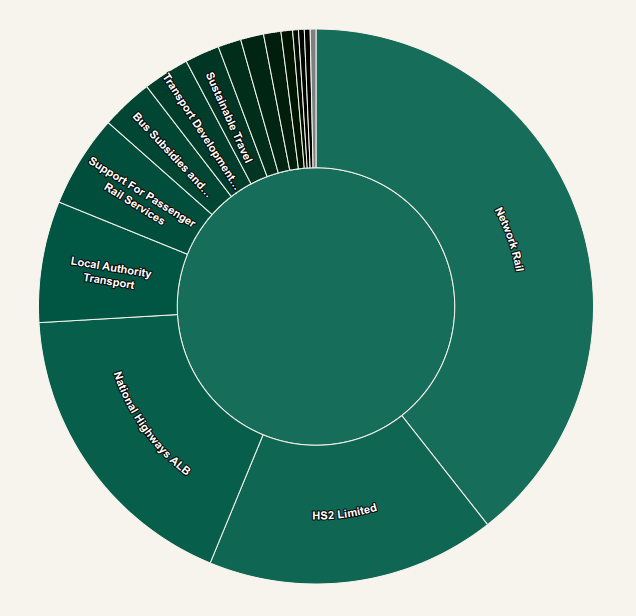
Here’s a chart from wheredoesitallgo.org. It’s a detailed breakdown of the UK Transport Budget for 2025/6.

According to the chart 63% of the entire budget gets spent on rail. Most of it as a continual annual liability to support the current rail infrastructure and attempt to make tickets somewhat less than prohibitively expensive.

Actually the amount spent on rail is £3 Billion more than shown here. The missing £3 billion is hidden in budgets to “Local Councils” and “Devolved Governments”

A significant amount of the budget is being spent on the development of HS2. That is the building and commissioning of a new rail line from London to Birmingham.

In fact the annual amount being spent on HS2 alone is just short of the entire budget used to maintain and upgrade Britain’s Motorways and major roads (The Strategic Road Network or SRN)

The total amount spent on Rail is just less than four times that spent on the Strategic Road Network (see National Highways ALB in the chart). So it would be reasonable for you to expect that the number of passengers travelling by rail would far exceed the number travelling on the Strategic Road Network.

But if you did think that was the case or even if you thought they would be somewhat similar, you would be wrong. And by wrong, I mean wrong in Spades.

Just 8% of passengers travel by rail. Meanwhile 34% travel on the Strategic Road Network. About 50% of all passengers travel on roads maintained by local councils

In total ten times as many passengers travel by road (of all types) than by rail.

Four times as many passengers travel on the SRN than travel by rail. Yet the SRN gets just one quarter of the money from the transport budget to that lavished on Rail.

The net result of this is that each passenger on the railway on average gets around 16 times the amount spent on them from the Transport Budget than does a passenger on (say) a motorway travelling in either a car or an National Express coach..

So Where it all Get Spent?

Even though each railway passenger gets about 16 times the spend than a road passenger gets, surely with all the talk of levelling up, it means that a great deal of that money is spent up North?

Sadly: No.

Most of that money is spent in and around London. 70% of all rail journeys are focused on London. Of that 70%, almost all (88%) is commuter traffic. The net result is that 60% of all rail journeys in the UK are accounted for by London commuters. Just 10% of all UK rail journeys are inter-city.

At the end of the day, non London rail passenger traffic accounts for barely 3% of the total passenger traffic on road and rail in the UK.

That’s how things stand. Nothing is getting better.

Governments of all colours have been obsessed with rail. While the Strategic Road network languishes we have shovelled money into one gold plated scheme after another. The latest debacle is HS2.

Most of the Transport Budget in in reality little more a hidden subsidy scheme for London firms and their employees. They get the Lions share of the budget. While the rest of the country gets the table scrapings.

This can’t (or rather shouldn’t) go on.

In another post (or two - TBD aka in the "future") I’ll deal with HS2 (and rail freight traffic) and how it will make little difference to the North but will in essence act as yet another London transport subsidy for London businesses and their commuters. I’ll also detail how much the subsidy comes to per commuter and how this destroys prosperity, development and job opportunities in the North and regions.

This post was originally published on SubStack but has been moved here. Heres why

Who are the Labour Voters in May 2026?

An occasional series on main political Parties & their demographic support.

First of all I suppose I should possibly title this “Who were the Labour Voters in 2026” because with the rise of the Green Party all bets are off at the moment. As well as that we have the local elections coming up which by the sound of things are going to go badly for Labour. But Local Elections are not like General Elections. They have a much lower turnout and can often be seen as a safe place to make a protest vote.

Consequently I’m using the last two General Elections as the database. I’ve built a table of the demographics for every constituency in the country. This is so I can examine the demographics for every winning Labour seat and potentially see which are vulnerable and which are not.

Labour’s National Vote Base

But first of all lets look at what could be called Labours national core vote. Here’s the total number of people who have voted in every general elect back to 1987:

So the Labour vote in 2024 that gave them a landslide victory was actually the third lowest vote they have had in the last forty years. Notably it was considerably lower than that achieved by Jeremy Corbyn when he lost in 2017.

Only in the 1997 General Election was the overall National voter turn-out high for a Labour victory. In 2001, 2005 and now in 2024 the national turn-out was low and in two cases actually below 60%.

But it looks like there is (or maybe was) an irreducible core Labour vote of around 9.5 million.

Labour Support by Age Group

So what age group(s) support Labour? Of course all age groups support and vote Labour. But there is a heavy bias towards younger voters.

Even though Labour has a very large lead in young supporters this does not necessarily lead to more votes. Turn-out (aka those who actually vote) for the 18 -24 age group is dismal.

Turn-out by Age Group 2024 General Election

Here’s the estimated turn-out by age group for 2024:

The reason the Ipsos figure is lower is that it includes ALL people within that age group. Many people are not even registered to vote and they do not even show up as non-voters in statistics based on registered voters.

Proportion of Party Vote by Age Group 2024

If you take an average of all the winning seats per party in 2024 you get this:


NOTE: The above figures relate to the electorate size for that age group NOT the number of that age group who voted for the respective party.

Notice how (Nationally) Labour winning seats have a lower overall turn-out and a higher percentage of young voters. Meanwhile the demographics of winning seats for the Conservative, Reform and Lib-Dems are very similar to each other. They have more support from older voters and less from the young than Labour or the Greens.

You may think that a few percent on these averages will make few differences. If they average were the same across all seats that possibly would be true. But the average hides massive differences within parties and particularly within the Labour party.

So Why the 2024 Landslide?

It also helps explain the last Labour victory. The fall in turn-out between 2019 and 2024 of 7.4% meant 3 million voters stayed at home. Older people are the predominant voting group. Statistically their vote per capita is worth twice that of young electorate members. Predominantly the 65+ age group voted for the Conservatives. But in 2024, disillusioned, many stayed at home. More voted Reform.

While Labour lost votes from 2019 to 2024, they lost far fewer votes than the Conservatives. Consequentially they actually won some seats from the Conservatives when they achieved a lower vote count in that particular seat than they did in 2019!

Labour and the Next General Election

This was written before Labour’s calamitous local election results in early May 2026 which were significantly worse than even I was expecting. So I’ll let the dust settle a bit before making any predictions. But I’ll leave what I wrote as a reminder I need to still do this!

But it is not rosy for Labour. They have many seats that depend on both a loyal Labour young vote and a low turnout. If either of those items change (and both may well do) they are likely to get hammered.

In a future post I’ll list the seats I think will either fall to the Greens or get them a close run. At the other end I’ll look for Labour seats that could fall to Reform though I think these are far fewer.

Looking at it the other way round I think it fair to say that the list of seats Labour could win off other parties would be more-or-less empty.

This post was originally published on SubStack but has been moved here. Heres why

You Get More Right Wing As You Get Older. Really?


Why this right wing drift is (perhaps) an illusion

It is a common mantra that as you get older you politically move to the right. There is even a graph which shows a cross over age where those below it are more likely to be left wing while those above it are more likely to be right wing. Here’s a version of it from YouGov. (it’s a bit old - 2017 but shows this perfectly).

Of course, it’s no longer just mainly Labour versus the Conservatives. But basically if you were to draw this today making it Left wing vs Right wing instead, it would look much the same.

This graph is from a reputable polling company using reliable data. So it is perfectly reasonable to assume the graph is correct. And (in its way) it is!

BUT (and it is a big but) it doesn’t tell the full story. It can lead to a belief that a typical radical 20 year old will, by the time they reach (say) 40 be voting Conservative or even Reform.

Of course that can happen and probably sometimes does. But it is very far from a given and I would suspect very few young, ardent Left Wing voters will actually make that journey.

So where does this graph fall down? Again I repeat - the graph (in as far as it goes) is without a doubt - correct!

Lets illustrate this with the likely political journey of a young left wing voter. Lets call her Jayne.
Jayne is 20 years old and once avidly supported Jeremy Corbyn. She now bats for the Greens or maybe just the wilder realms of the extreme left of the Labour party. She is passionate and committed to her political beliefs.

Is Jayne (in 20 years time) going to start eulogising Margaret Thatcher?

Hardly likely is it? But that does not matter. Why? Try this as an explanation.

Sure. Jayne and her fellow young voters overwhelmingly support left wing parties. But they are unusual within their age band.

They are unusual because they actually vote. But even more so they are unusual because they are interested enough in politics to ensure they are properly registered to vote. Somewhere around 20% of 18-24 years olds are simply not even registered. They are not on the electoral register and so cannot vote. (Some estimates put this as high as 30%)

In 2024 the turnout for the General Election was the lowest since 2001 and the second lowest since 1918. It stood at a dismal 59.7%. But that is across the board. Turnout for the 65+ age group nationally was estimated to be the high 70’s to 80%. For the 18-24 group it was estimated to be 46%. But that is 46% of registered voters. If you include the missing 20% who are not even registered that reduces to 34% (Ipsos put it at 37% so I’ll use that from now on).

So while Jayne and her friends drive a 70% left wing vote in their age group, at the end of the day, of people in the 18-24 age group only 25% voted for the left wing candidates.

Sure: Even less voted for right wing parties. But however you cut it, a significant majority of the 18-24 group simply did not vote. Over 3 million of the 18-24 group stayed at home on election day 2024.

But as people get older they tend to drift towards voting. Turnout by age band increases. More and more people in an age group vote and fewer and fewer go unregistered.

So while Jayne may still stay true to her left wing values as she gets older, the new voters that join her at the ballot box may well hold entirely different views.

This makes it appear that the original younger voters are moving rapidly to the right but in fact the dilution of the left wing bias is due to an increasing number of individuals engaging with the electoral process as they get older.

Here’s an estimate of the turnout for each age group at the 2024 General Election:

And here’s how each age group voted. Remember this was the General Election where the Conservative vote collapsed. Even so, with a 73% turnout those elderly 75+ Conservative voters produced more than double the votes that the 18-24 group did for Labour.

Also notice that the 75+ group produced as many votes for Labour as did the 18-24 group! In other words when comparing these two similarly sized groups both had roughly the same number of Labour supporters. The young Labour vote in 1980 was now the old Labour vote in 2026. Maybe?

So I’d suggest that while a drift to the right is quite possible as a person ages, the amount of drift that will happen (for these young voters in particular) is generally overstated. Those who vote young may well keep their fundamental political affiliations as they get older. What changes is that those initially less engaged with politics come along and start voting too.

And they are far less likely to vote for Left wing candidates.

Originally published on SubStack before being moved here. Read more in this post.